

 Spotify

 Amazon Music

 Apple Podcasts

 YouTube
401: Internal Improvements - The American System
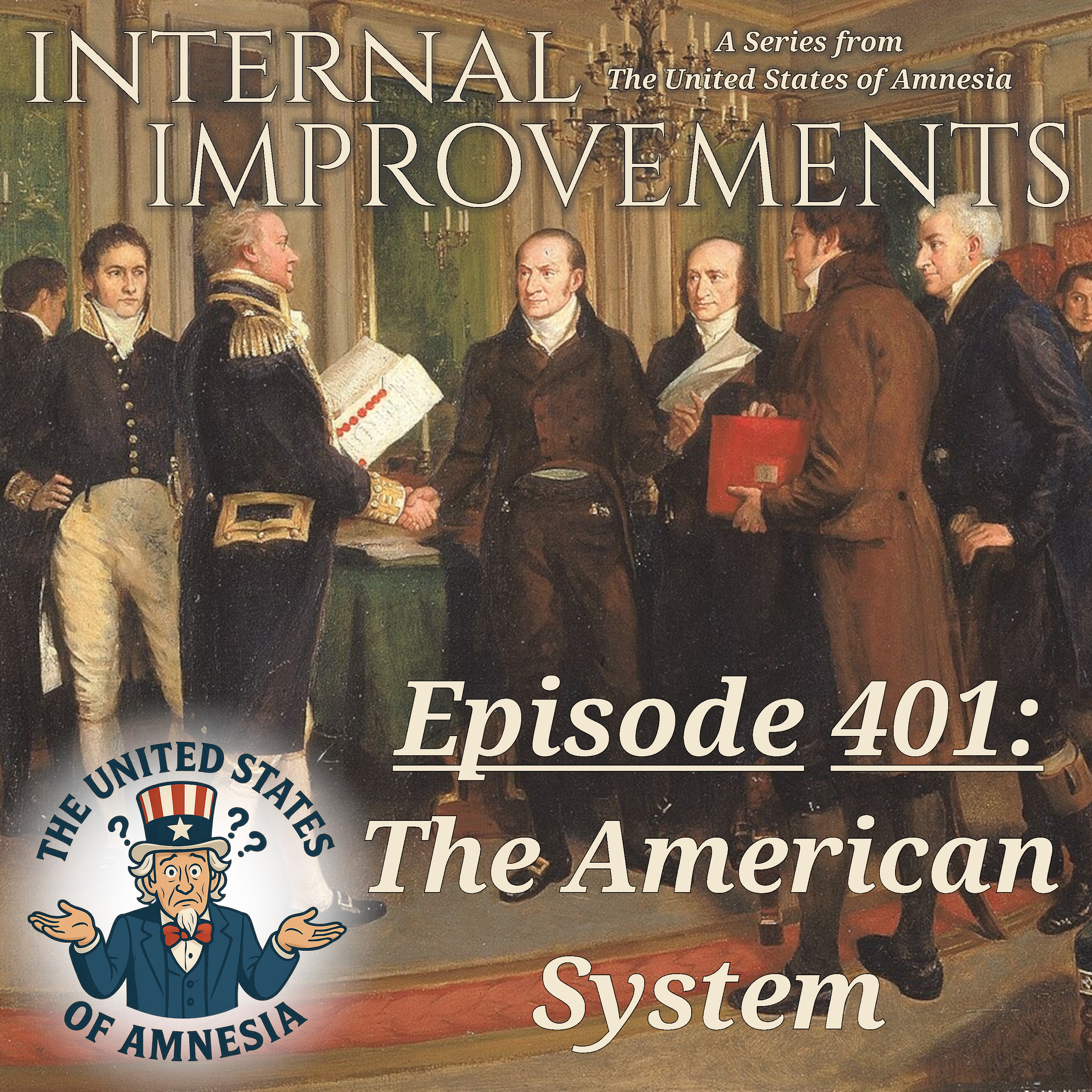
In the 1820s, Henry Clay envisioned a bold new role for the federal government: building America’s infrastructure, strengthening its economy, and shaping the nation’s future. He called it the 'American System.' But was the Constitution willing to let Washington build?
In this premier episode of our new series, Marshall traces the battle over “Internal Improvements” from Clay and John Quincy Adams to Andrew Jackson and the rise of populist democracy. What began as a fight over roads, canals, and federal power soon became entangled with the deepest conflict in American politics: slavery. For the next three decades, Southern opposition would help derail the vision of a more economically activist federal government.
This episode begins a series exploring what Americans wanted their government to build, what they believed it had the power to build, and why those questions still haunt American politics.
0:19 John Quincy Adams, Inaugural Address 1825. Okay, now I need some context for that. And what does this mean? Well, this is... Him laying out his program for the United States. This sounds to me like an homage to the ancient civilizations, particularly ancient Greece and Rome, with their infrastructure, particularly in thinking of Rome, the aqueducts, the road system, the bridges, even the public temples and governmental buildings, and even the Colosseum. Welcome to the United States of Amnesia, the podcast that reminds us of what we have forgotten. History doesn't just tell us where we've been, it shapes how we understand the present. Yet the past is never as simple as we remember it. Over time, history becomes filtered through politics, ideology, and popular myth until the original story can be hard to recognize. History may not repeat itself, per se, but it often rhymes, as Mark Twain once remarked.
1:31 Join Marshall Newman, Mike Mendenhall, and Blake Hinckley as we explore history, politics, religion, and the connections between them. By understanding the past more clearly, we can better understand the present and prepare for history's next rhyme. In the 1820s, Henry Clay proposed an activist role for the United States government in envisioning, funding, and overseeing improvements in America's infrastructure and in taking action to ensure economic stability in the fledgling United States.
2:16 He called it the American system. But opposition to such activism arose based on the observation that the Constitution does not explicitly permit it. This series we call The American System explores America's choices in giving government a role in building things and in addressing economic challenges during the period from the War of 1812 through the American Civil War. In this episode, we discuss how Clay and President John Quincy Adams, who proposed a program of internal improvements to American infrastructure were stymied by populist Democrats who feared that a government empowered to do such things would also gain the power to abolish slavery. Let's look at the state of the country in the early 1820s. America in the 1820s, after the War of 1812, might have been united politically. But it wasn't united economically. It was very difficult, except by moving goods and equipment up and down the Mississippi River to get goods, products, et cetera, to the markets of the East Coast.
3:34 Or by mule cart. Or by mule cart. Over roads. And I remember hearing once that different states had different rules for road quality. And one state, Ohio or someplace, their roads couldn't have stumps any taller than 12 inches in the middle of the road. And then there was another state, I forget which one, which was more liberal about things, said the stumps could be 18 inches. But this was the state of roads in the United States in this early period. That could be troublesome for the carts going across and the mules. The most effective way to move goods and... items for sale was over water routes. And so one of the things that was being proposed here were a system of canals, also a system of roads, but canals were definitely the easiest way to facilitate trade in the 1820s. You could move a great deal in a barge. Yes. More than you could carry on a mule or pull in a wagon. All sorts of things recommended themselves. The example of the Erie Canal, which was a state project, not a federal project, and the aftereffects on New York City was an indicator of just how impressive the results could be if you're able to establish these links between the West, where agricultural goods and things like furs are brought in. What that did for New York, it made New York the single biggest trading hub in the United States with links throughout
5:05 the East Coast and also to Europe. The Erie Canal runs west to east between Lake Erie and the Hudson River. It was completed in 1825. And with water traffic able to reach it from the Atlantic Ocean via the Hudson River, was the first navigable waterway connecting the Atlantic Ocean to the upper Great Lakes above Niagara Falls. In other words, Lakes Erie, Huron, Michigan, and Superior. The opening of the canal vastly reduced the cost of transporting passengers and freight from U .S. territory west of the Appalachian Mountains. The Erie Canal accelerated the settlement of the Great Lakes region, the westward expansion of the United States, and the economic ascendancy of New York State in general and New York City in particular. So you basically have rivers as a way of moving things around and very terrible roads. In the 1820s, John Quincy Adams and Henry Clay, both in the Adams administration, and Clay separately as an unsuccessful candidate for the presidency, attempted a bold program of federal initiatives that were designed to improve the economic health of the nation, allowing both the nation and its citizens to realize their potential. The program, advanced by Adams, was referred to as Internal Improvements. Henry Clay's was known as the American System. The terms can more or less be used interchangeably. While there are some differences between philosophically,
6:36 they are more or less the same approach to advancing government power. Both envisioned a more activist role for the federal government. This was not a sudden or crazy notion. Measures such as these that they were advocating could be traced back initially to those proposed by Alexander Hamilton in his 1791 report on manufacturers to Congress. Most of the founding fathers, even Hamilton's foe, Thomas Jefferson, according to his biographer, Duma Ballone, believed that some ability to improve the nation's economic health was within the power of the government and would be beneficial to the condition of the United States. The Cumberland Road was a road through Maryland heading westward, correct? Yes. Toward what would now be West Virginia.
7:33 Yes. Back then was part of Virginia. It was also called the National Road. Yes. Right. But that was a major construction project of the— Major construction undertaking in order to facilitate the development of the West. Of the 1790s? Yes. And when people talk about the West in this context, they're not talking about the West as we understand it today. They're talking about what we would now call the Midwest. The Midwest, yes. The West was still part of Mexico, mostly. And this was an important component that you bring up. The idea of being able to settle the West, that is part of unlocking this potential. But it's also about being able to move goods and products that were produced in the West to the East Coast for sale there and elsewhere. And at the time, what farmers in what we would now call the Midwest, then the West, they had to move their goods.
8:21 to market essentially by moving them down rivers the ohio river the missouri river the mississippi river whatever was nearby down towards the towards the south yes and it was a expensive laborious time consuming uh trip to do that so part of the idea was to give them better connections to the rest of the country and the outside world it cuts them off also from the east coast too yes you know and and and really being able to sell things in europe so like if you've got like some burrs that you amassed. There's only so much you can put in your mule cart. Yes. And drag across those terrible roads. Yes, with the stumps and so forth. Let's look at the political landscape leading up to the election of 1824.
9:06 The election of 1824 brought John Quincy Adams into the White House. To lay the groundwork for this, there is only one national party at this time. The Federalist Party has disappeared and was unable to gain any more positions of authority, such as presidency. After John Adams. Now, this one party system that we had here, the Democratic Republican Party, this was this was Jefferson's creation. And because of the primitive nature of politics in this one party state, there were actually five candidates campaigning for the presidency. All of them were nominated by various elements of what was known as the National Republican Party, today's Democratic Party. It could involve something such as. compliant state legislatures nominating. I mention this because we need to look at three of them, John Quincy Adams, Henry Clay, and Andrew Jackson. As no candidate won a majority of votes in the Electoral College, the election was decided in the House of Representatives, as specified by the Constitution. Clay, who had made the first of many attempts at the presidency, was not one of the three candidates that were considered, which is unfortunate for him because he had the kind of pull within the legislature, both as a former Speaker of the House and also a member of the Senate, to install himself and get forth his programs. He was from Kentucky.
10:38 He was from Kentucky. And what's also interesting about this election is we're seeing people from outside of the East Coast actually running for the presidency. So you have Jackson running from Tennessee. You have Clay running from Kentucky. You have Adams, of course, who's from Massachusetts. So he was not able to actually achieve this position as one of the first three. So even though he and Adams were about as unlike as any two people could be in terms of personality, they did share a common vision for the future of America. And this would in the short term be beneficial for Adams as it would be for Clay. Clay managed to find Adams enough votes in this election in the House to ensure that he became the president to triumph over Andrew Jackson, who was soon to establish his own competing vision of America with Van Buren. What's going on here, though, is that Adams and Jackson and all the others, they're not necessarily being... And I think this is an important consideration. They're not necessarily being elected by a popular vote, even if we factor in the Electoral College. It is up to the states to determine how the delegates for the Electoral College are selected. And sometimes in some states, such as New York and South Carolina to name two, it's the legislature that's doing this. They're the ones that are doing the voting.
12:07 Election Day is just a day like any other for the people as a whole here. There is this notion that Adams came in and he was kind of a minority candidate, a candidate who did not have the popular will. The popular will is determined in this case by votes in the electoral college, something to keep in mind here. Electors were not tied to the popular vote in those days. No, not necessarily. The way they are now, they were supposed to use their own. conscience or something. The popular vote basically informed them what people in their state thought. But they were not bound to honor that. They could do something different if they wanted to. And there have been unfaithful electors over time. I mean, it was changing. And in Van Buren's state of New York, there was a lot of considerable pressure to make this not a function of the legislature, but also a function of the people as a whole being able to vote. And there was even an increase in one's ability to be able to vote. There was, in this coming age of democracy, 7 to 8 percent of the U .S. population actually was able to engage in voting, as opposed to the one or two percent that elected the first five presidents of the United States. White -propertied men. Yes. So to get back to kind of the comings and goings, Clay's assistance in getting Adams elected prompted Adams to select Clay to the office of Secretary of State. This was the office that if you held it, everybody had. moved ahead
13:40 to be president up until that point. Everybody who had been president was a secretary of state. Adams also sought to appoint Jackson to the cabinet, kind of like in a form of, say, like, you know, what we would associate with Lincoln, a cabinet of rivals, but Jackson refused. Jackson and his supporters would insist that this amounted to... ordinary politics that this was somewhat of a corrupt bargain, as though deal -making and so forth is not part of the whole experience of politics as a whole, going back to ancient times here. The idea of corruption, I think, is going to be a theme, too, as we look at criticisms of these proposals for infrastructure improvement.
14:25 Yes. Just to finish that part off, Jackson would insist that he ought to have been elected president in 1824 due to what he termed the popular will of the people. But this was not the only way the president would be selected. If it was a matter of the will of the people, then he probably wouldn't have lacked a majority of votes in the electoral college. Still as now, Jackson's feigned outrage was useful in the subsequent. political contest. Let's bring this back to the American system and the internal improvements. Certainly. But I think it's worth understanding that there are certain dynamics that are afoot that are going to affect this. And this involves questions about popular will and what is good for the nation.
15:10 I know where you're going with this. So yeah, I see where you're going. So let's move on toward it. The idea that Adams and Clay were trying to advance with their respective programs was to promote greater harmony among the industrial, commercial, and agricultural interests in the country. The idea behind this was to allow the United States to reach its full potential and advance economically. This did involve settlement of the West and having people go out there and exploit the resources to make better use of them. They favored a tariff on manufactured goods, not on items that were not grown or produced in the United States like now, but to protect industry so that it could catch up with Europe, and in particular Great Britain, then in the initial stages of industrial revolution. Clay also felt that economic development of the United States was necessary for it to remain independent.
16:03 They figured that by unleashing this potential, this would ensure the United States future as an independent country. In an 1820 speech, Clay insisted the United States was still only sort of independent of Great Britain, politically free but commercially slaves. And Clay had a point given the influence of the trade with the Caribbean, which was British at the time, and still had on the United States' economy and the need to diversify trading partners, as we saw in our China series. The South in particular, I believe, relied on Great Britain for importation of cheap goods, manufactured goods and things like that. It sold cotton to Great Britain. Great Britain sent it fairly cheap manufactured goods in exchange. It was part of that part of the economy. Well, let's talk about that a little bit because we have not had Bretton Woods yet.
16:55 And so the ability to have some sort of currency that is interchangeable. Unless you're talking about gold or silver, which is scarce. Bretton Woods is the post -war agreement that kind of— Post -World War II agreement. World War II agreement that allows for— conversion of currency and to facilitate trade amongst nations there. Based on a gold standard. Based on a gold standard, yes. To kind of regulate international currency. But that's after World War II. That's long in the future. That does not exist now. So that dynamic does not exist. So trading goods, what people would do, it's not like the plantation owner is going to go off and say, I need a new settee for the parlor there. He is going to take on these manufactured goods from Britain as payment.
17:39 This is an easier way to facilitate payment. So it's closer to a barter system than a money economy. Because, again, gold and silver are the only things that are kind of convertible at this point. And having this ability to gain access to these manufactured goods and then sell them once you get back into the United States with them, that's a way for them to make money. This is kind of good for them because this solves the problem of making sales and stuff. You sell your stuff. You get money in pounds. You go buy stuff. You bring it back. in the ships that were emptied, kind of merchant trading there. But what this doesn't do is, say, in New England, if you have a furniture, since we're still talking about a sofa here, you have a furniture manufacturing system, they can't really sell much to the South because it's all coming in at cheaper prices from Britain. So this is how these things...
18:42 could be working against each other. Agreed. But the point seems to be, though, from the sales point of view, they were perfectly happy with not worrying about whether the New England manufacturer made any money or not, as long as they got their cheap settee from Great Britain in exchange for the cotton. They were fine with that. Yes, they were perfectly fine. And that's an important thing to note as we go through the opposition, I think, to the internal improvements in the American system. Now, we've kind of talked about how this would benefit, say, people living on the East Coast, people who are urban dwellers.
19:33 So there were benefits to the farmer because the American system, the internal improvements, offered federal subsidies for roads and canals to develop better and more competitive markets. Adams, given his love of learning and experiences in Europe, also favored the establishment of a national university along the lines of Cambridge or Oxford to enhance access to education, and most notoriously of all, in populist circles, an array of astronomical observation posts, which Adams referred to lighthouses of the sky. Now, we take it for granted that the government has an interest in being able to explore space. Adams was kind of an early adapter to this idea with this whole system of White Houses that existed.
20:24 The populists hated this. although they were able to put through a certain institution known as the Naval Observatory here in D .C., but this was the only one of the reforms that Adams was able to pass in his first term. There was significant opposition to the United States government being involved in any kind of scientific endeavor. The Constitution doesn't say that the government could get engaged in science, therefore it can't. And it was widespread. I mentioned, I think it was in the America First series, I mentioned something called the United States Coast Survey that used to exist. And they kept trying to put it out of business in the 19th century because it did scientific things. So the government shouldn't do scientific things. So this kept coming up in many, many contexts back then. Another thing that was on the agenda was to establish a naval academy. And this was proposed to be something similar to West Point, which was in existence and served. to develop an officer class for the Army. This was going to do the same thing for the Navy. The Adamses were always big in favor of, you know, a large Navy. They were Navy people here. This would not be established under Adams, but in 1845 under James K. Polk's Secretary of the Navy, George Bancroft. One of the big projects that they favored was a national road from New Orleans to Washington and points east. as well as the Department of Interior, which would fund these internal improvements with land sales.
21:49 This was an important component, and this is something that we will see persisting into the future here. And this is promoting the settlement of these lands by land -hungry Easterners, something that Clay felt the West needed to be developed. We needed to allow settlers to go out there. We needed to have a way to facilitate the purchase of land. And this was seen almost as a form of national defense because at the time we do not control the entire continent. And there was concern about European powers coming in and basically nipping at the edges of the American state such as it existed in 1825. So what is now Canada was still a British colonial possession at the time. Yes. Mexico, two -thirds of Mexico made up what is now the western United States. I think Mexico became independent only in 1820, was it?
22:41 Yes. From Spain. So, you know, you did have significant parts of the United States which were directly bordering on foreign powers who could be a threat to the United States. And, I mean, given the performance of, let's just say, the U .S. military. as it existed. And the War of 1812 wasn't very good. It was miserable. It wasn't just a matter of not paying people. It was poorly organized. And this idea, this sort of like traditional idea of opposition to standing armies and military training, that kind of was proven to be a bad idea during the war. Recently recruited untrained militia can't really stand up to the most well -trained professional army in the world. Who knew? Yeah. Well, here... But one of the heroes of the War of 1812 was none other than Andrew Jackson. Yes. Now, here's an interesting... Jackson's...
23:35 greatest biographer is a guy named Robert Remini and Robert Remini talks about Jackson when he was leading his own militia and he said by and large what these militias were were a chance for guys of a certain age to get dressed up in military finery and to like parade around the square in hopes of getting the attention of the fair sex, as he refers to it. So it was a dating system more so than a system of defense. Jackson was different in the sense that he did insist on discipline and his forces were actually well trained and capable. But he said, Remini says that by and large, this is an exception rather than the rule. So if we want to look at sort of root causes, you know, how we use the militia is kind of like it wasn't used as envisioned at the time there. For those unfamiliar with the history, Jackson. was at the Battle of New Orleans at the beginning of 1815, and the British were defeated pretty soundly in the Battle of New Orleans. There's a country song about it that was written a lot of years ago. But anyway, that's where Jackson came to national prominence, as my understanding is, from the Battle of New Orleans at the very end of the War of 1812. Although the war was over because Adams and Clay had already negotiated it at the Treaty of Ghent in 1814.
24:59 But the word had not arrived in New Orleans yet. No, it hadn't. To either side. To either side, yes. So that battle was fought after the war ended. Now, there were some differences between Clay and Adams, and this was in the area of foreign affairs. Clay was much more enthusiastic about recognizing the nascent republics of Latin America than Adams was. Adams wasn't opposed to it, but he wasn't really wanting to force the issue. The forces that would stand in opposition to Adams and Clay would be horrified at the thought of treating governments headed by Hispanics as equals, and they were concerned that this could undermine the racial code essential to maintaining slavery. Although slavery is not discussed in this context, this was an issue that I think was present in the background as a force for shaping the debate. My understanding of this is that Clay's And Adams' goal was to stitch together the United States into a unified whole.
25:58 Yes. Through transportation, through economic relationships. Interrelationships. Interrelationships. And there's a summary that I've seen here about how this was supposed to work. But the idea in Clay's vision was that the East would manufacture goods for the rest of the United States. The West, which we would now consider to be the Midwest. Yes. It would grow grain and it would raise livestock. to feed the workers in the East. Yes. The South would grow cotton. The cotton would then be used to supply northern textile mills to make textiles in the United States. That was his vision. take a quick step back and realize the colonies started out and they you know this was a very regional approach yes to settlement and the colonies became the states they were almost semi -sovereign Well, they're sovereign realms because they do have sovereignty over a large number of issues and aspects. Right. And travel was difficult. Yes.
27:15 And you couldn't get very far. A lot of people didn't leave their own state for the most part. So you have, and they were kind of glued together under the Constitution. With this Constitution, yes. And remember. The Articles of Confederation failed because it didn't have enough federal power. So the Constitution was in some ways a redo. Yes. Well, it was definitely a different approach and it was beyond anything the Articles of Confederation had mentioned there. So the Articles of Confederation were very weak because the colonies forming the United States did not want to have a strong central government at all because they didn't trust one another. They didn't want each other to use the central government against. one another. The Articles of Confederation went into effect in 1781 and remained in effect until 1789 when the U .S. Constitution officially went into effect. The last state ratified it in 1788, that was Rhode Island. So the Constitution was in effect and then we had the modern presidency created with George Washington becoming the first president in 1789. But keep in mind that even under the Constitution, there was concern that the government federal government would become too strong, would infringe on state sovereignty.
28:30 And as a result, the Bill of Rights includes issues that preserve state sovereignty, that reserve rights to the states and things like that. So this issue of having too strong a federal government was right there at the foundation. And the sense of a national unity that we have now, I don't think came along until arguably, well, certainly not until after the Civil War. And some argue until not after, it's like World War I. In a lot of ways. But that's another issue. All right. Going back to the foundation. All right. So we've got the Constitution. There are certain powers that the government, the federal government, can do. Yes. And there's plenty of stuff that is unsaid in there. You know, you can make an argument that some of it's implied.
29:15 Sure. Yeah. But there are certain powers that the government has. And there was a large faction. that believed if the Constitution did not explicitly say that the federal government can do blah blah blah, that you can't. Yes, and I looked at this when doing the research for it, and it's kind of interesting. The federal government doesn't actually have the power to go in and conquer and incorporate new territory either, which is what the opponents of internal improvements were really much hell -bent on. But we did a lot of that. We did a lot of that because what happens, unfortunately, is that we end up with an era of populism in which Jackson and company continue to... pursue a policy of manifest destiny, which was very popular with people, the idea of a bigger, better United States. That's later on. That's later on. Although the Constitution does not specifically... So, no one... To get back to the notion of what the Constitution was and what the Constitution said, no one, especially the leaders in the passage of the Constitution, absolutely
30:46 ruled out the possibility of the federal government having a role in the economic sphere. But then there was a debate over that that came along very early in this entire discussion of internal improvements or the American system. So this comes down to a fundamental disagreement over the Constitution, which... still exists today to some extent, over the difference between strict constructionism and what I've heard called loose constructionism, but also apparently it's called broad constructionism. Strict constructionism holds that the United States government, the federal government, cannot do anything that is not explicitly mentioned in and permitted by the Constitution. You cannot assume it has any other powers at all that aren't explicitly mentioned.
31:35 Those who support the broad constitutional or loose constitutional interpretation, in contrast, say that the government actually has fairly far -ranging powers to do things under the general welfare clause. They're allowed to provide for the general welfare. And also under their power to regulate interstate commerce. Those are the two foundations of that argument. It largely remains unresolved today. One or the other will wax or wane depending on who's in power. But the argument continues today. Let's dive into the provisions of the most controversial elements of the Internal Improvements Program, if we can be permitted to call it that. The Bank of the United States, which functioned as a kind of national bank, both in terms of promoting credit and stabilizing currency, was an immediate target for these individuals, these forces. This is kind of a difficult concept. I'm going to try to explain it as succinctly as possible. The national bank was kind of like this vast capital reserve. institution that existed to fund things on a rather large -scale basis. Like, for example, the First National Bank funded the Louisiana Purchase, which was millions of dollars. This was the First Bank of the United States was the term they used for it, right? Yes. The First Bank of the United States. Where we are in things now is they let the charter lapse on the First Bank, and then They found it very difficult to wage the War of 1812. This was one of the big
33:06 problems with the War of 1812, is the lack of access to capital. So one of the things that they did, kind of the lessons learned, was to recharter the Second Bank of the United States. So there was this institution that was capable of providing the federal government and others with large access to capital here. So this was something that for some of these programs that were wanted, this was a necessary institution, having a federally chartered bank. It also stabilized currency and interest rates. So it kind of acted like the Bank of England in some respects. This was Hamilton's original vision for this institution.
33:47 It was a kind of public -private hybrid institution that would kind of be like what the Federal Reserve became 100 or so years later. The way it worked, I think, tell me where I'm wrong, is that the federal government controlled its money and it placed it in private banks. And that was the private... As the Bank of the United States, you had an account in private banks. And that's where the tax money went. And that was the public -private partnership that they worked out. Yeah, okay. It was a sort of favored bank that existed because it had all these... other powers that were beneficial to the federal government. So the federal government is using it to place its cash deposits there. So that was the first Bank of the United States in Hamilton's time in the 1790s and such. They did away with it? Yes. They did away with it. Why? because they were opposed to the power of this bank having its influence.
34:48 This was something that Democrats really hated, like Jefferson's Democrats really hated this Bank of the United States. They did not like banks. They thought them sinks of corruption, etc. However, during the War of 1812, without a bank, the Treasury went bankrupt. and soldiers were not paid. And as soon as the war was over, they rechartered a bank, and they kind of learned their lesson. This would have been Madison, Jefferson's protege. And that's known as the Second Bank of the United States. Which is what is in existence in the 1820s. That was chartered in 1816. Yes, right after the end of the war. The war ended in 1814, it was chartered in 1816. Yes. So let's frame this real quickly. We created a bank to handle federal money. Yes. People opposed it because they thought it gave the federal government too much power and because they thought it led to corruption as well. They thought there were like Eastern banking interests that were corruptly handling and benefiting from the money. So they did away with it. Then they went broke fighting the War of 1812 and decided they needed that bank after all. Yes. Then they chartered the second bank. Yes. So now here we are again. Here we are again. It's still controversial. Still controversial for the same reasons. Yes, for the same reasons. And it's, you know, we will get into some of this. The original institution, as we said, was a creation of Hamilton. And despite disdain from the likes of Jefferson, who wasn't above using the bank as a means to finance Louisiana purchase, had survived with a second charter
36:18 into the 1820s. For a time... The problems the United States had in funding the War of 1812 without a national bank was sufficient to prevent opposition to the second bank. A national bank capable of providing credit at consistent interest rates would have been useful, the charter for the first bank having expired in 1812 and not renewed. Despite the bank's utility, particularly in light of financial difficulties incurred during the War of 1812, it was to be opposed and eliminated by Jackson, Van Buren, Calhoun, etc. It was eliminated in, the charter was revoked in 1836. Yes. It existed for 20 years. And then it technically continued to exist, but it withered away and finally disappeared in like 1841 or something like that. Under scandal. It had no... U .S.
37:06 money in it anymore. I think that's how Jackson got rid of it. He just took all the money out. Yeah, he took all the money out and he gave it to state banks. But we're not there yet. We're not there yet. The problem with all of this was that without a national bank, a bank of the United States, you had to put money in state banks. And state banks were fairly unregulated and unreliable. Yes. Some were better than others. Some were better than others, but some were pretty sketchy banks, apparently. So without regulation, without any kind of controls, banks doing whatever they wanted to do and scattered among different states under different regulations, the financial picture was a real mess in the United States. And so consider this. If you have very unreliable financing for projects, you are not going to be able to construct U .S. Steel, for example, the sort of big... corporations that existed after the Civil War are just not possible at this stage.
38:02 Now, I will say this. New York had the strictest regulations known to man within the United States during this period. They had had a number of runs on the bank, and this was something Van Buren, as a political leader, was behind here. This set the stage for New York becoming kind of like the financial capital of the United States. You don't have a single source that you can go to outside of New York. And I mean, even if you're looking at New York with the big banks that are developing there, this is not enough to be able to fund a grandiose federal project or to fund a war of the size and scale of, say, 1812 or the Civil War, a national contest there. You do not have the resources to be able to do something like this. And you're having to go and... borrow from various other places, whose interest rates will vary. And they'll vary on the side of being higher rather than lower. And I mean, another issue that to consider is that there's nothing wrong with being a private bank. But if you're a private bank, you're a private firm, you're trying to make a profit. Yes. If you don't think that something is going to be profitable for you, you're not going to loan the money if you don't think the loan is a good risk. Yes. So you can't get the money to do the projects you want to do unless the bank agrees to do it. It's not like the government is allocating money in that case. It's trying to borrow it, and it can't.
39:30 And it's a sense of desperation, too, because if you're desperate for money, they're not going to basically run a charity organization. They're going to basically say, I'm going to charge you what I think I can get out of you in order to advance my profits. That's capitalism. That's capitalism. And this is something that I would argue the people that were opposed to a national bank did not quite. readily understand here. Well, from my research on this topic, it's not as if what they thought was idiotic or something. It's true that they didn't think a lot of the things through that you're bringing up. But there were problems with both the first and second.
40:14 banks of the United States from the perspective of their critics, which had some validity to it. So, for example, they said that it was an inherently corrupt system because it wound up letting the government put money into banks that favored Eastern banking interests. You know, nowadays you would say they were picking winners and losers is what people would say nowadays. It let them do that. There could be cronyism. I don't know the extent that there was cronyism, but there probably was some, I would assume, in that kind of an arrangement. So you kind of had Eastern elites loaning money to Eastern elites under the direction of Eastern elites and profiting off those loans and those kinds of things. The bottom line being that it isn't that the Bank of the United States, either the first or second Bank of the United States, were without fault.
41:03 There were some grounds for criticism of those banks. There were big advantages to having the banks. The critics were completely wrong to oppose at least some aspects of the banks and how they operated. I think to be fair, you have to say that. Yes. And I mean, I would argue that one of the things that the United States suffers from throughout the majority of its history is under -regulated banking. And this is... at the national level. And I mean, one of the issues that they also had was that the bank would tend to favor, like you said, picking winners and losers, but not just economically, but politically. And this is where Jackson has his issue with it. He views the bank, and this is somewhat charming, consider today's idea of equating money with speech and the ability of corporations to fund electoral campaigns. The idea that there was this institution that was actually operating within the political sphere, this commercial institution, this had to be eliminated in Jackson's mind because it had overstepped the boundaries of its natural sphere, which was economic. It was interfering in politics, particularly in the election of 1832. Jackson's second term.
42:18 Now, I will also add that the absence of having something like a national bank would create problems for the United States when it was fighting the Civil War, just to look ahead a little bit. And this will be one of the main incentives to kind of revitalize Clay and Adams's proposals in the 1860s. The Jacksonians also favored a kind of haphazard support of state banks and hard currency. Paper money was issued by uncapitalized state banks. It was permitted. But federal preference was for hard currency, gold and silver. Now, gold and silver are always in short supply, and being able to amass sufficient gold and silver to be able to carry out transactions is problematic for a lot of people, particularly people in the West. And this has kind of a chilling effect on... the purchase of federal lands. So Clay and Adams, they want people to be able to have access to land out west. Jackson and company, they want these payments to be made in gold and silver when you're buying federal lands, when you're gaining access to federal lands, which is going to make this that much harder. And it's unusual for people in public life to know next to nothing about economics. This Jacksonian approach is in a class by himself. in a sense that its course destabilized the U .S. economy, I would
43:49 argue. Okay, so let's review here. So at the time, we're talking in the 1820s, there was no national paper currency. No, there wasn't. The only national currency was what we called specie, meaning gold and silver. Gold and silver. Right, coins. Coins. Paper money was not the paper money of today. No. Were we making coins? Yes. Okay, so we were making gold and silver. Coins. Coinage. Yes. Okay, good. We had the Department of Treasury. Yes, we had the Treasury Department. They were issuing. And the Mint, and they were like putting out coins. Payments to the federal government were generally made in. gold and silver or specie.
44:30 That's where they got it. And so round and round things went in terms of this gold and silver circulating through the economy here. Government is going to use that money to pay for certain things, not nearly at the same level as it is now, but gold and silver is going to be in circulation through the government's coining system and so forth. And they could, you know, the raw gold and silver could also be purchased, acquired, and transmitted for sale of federal lands, which is a major source of revenue. Also things like the tariffs. But in terms of paper money, it was chaotic. Yes. It wasn't really necessarily backed by anything. The banks would have some specie, some gold or silver in their vaults, which backed the money. But banks... make money by loaning out more money than they have on hand.
45:23 That's how banking works. And so if you were to go back in and try to exchange your paper money for whatever gold and silver was in the vault, the bank would run out pretty quickly. Also, because the paper money didn't have any particular value attached to it, you could just print more of it. And what happens when you print more money? You get inflation. So these kind of problems are plaguing the early republic without any central control really over money because it was just done by individual banks. And with the paper money being under the individual bank's control, you didn't have any stable currency. There was no national currency, at least not paper money. So these were big issues that they were dealing with in the time of Adams and Jackson. And the states have a kind of odd and irregular approach to regulation. There is no single regulation of the banking system. Each state regulates the banks under its jurisdiction. It can have different regulations depending on what the state legislature decided to do. So again, all sorts of different rules. This gets very tangential, but if I am in, let's say, Tennessee, and I have a bank note from a private bank, can I go to Kentucky? Yes, you can. And use it. Maybe. Maybe. All right, so there's a couple of things that could happen if you did that. So one is, best situation, you get full value for your money when you take it to, A different state. A different state. The other is you might get a discounted rate, which
46:54 is less than face value. And then the third option is they don't even know what the hell this is and they refuse to honor it. Now, think about this in terms of being able to develop a kind of national economy. If you can't have your money be able to be used in different states or even different cities, you could get... banknotes from a city in Tennessee and go to a different city in Tennessee and they may or may not be accepted. So if you have Canadian money in your wallet right now and walk down to the 7 -Eleven and try to buy something with your Canadian money here in Virginia, you're not going to be able to buy anything. Unless it's gold or silver.
47:37 That's kind of what it was like between different states in those days. Or within states. Or within states. Or within states. Because it's like just because you're in a state doesn't mean that Bank A is going to accept your note from Bank B there. Were British pounds still circulating? Define British pounds. Are you talking like hard currency or gold and silver? I guess they only had coinage as well. Coinage would be accepted and they would weigh it. I mean like Spanish currency I think was pretty much accepted. In coinage. Okay. So if I had Canadian gold or silver. Yes. I could use it, probably. Sure. Oddly enough, it's through.
48:19 In the United States. Yeah. You know, if I'm in Kentucky. Spanish coinage was in use, especially, I think, in the South, which is closer to the Spanish. Yeah. The former Spanish Empire. And there's trading going on. People used Spanish money in the early United States. It was accepted because it was coin. Yeah. Right. Okay. I got you. It was specie. Specie. Yes. I know. We got to use that word. It was specie. As we already have alluded to, the changes to the U .S. government's role in infrastructure development, banking and currency that John Quincy Adams and Henry Clay championed met significant opposition through figures such as Andrew Jackson, Martin Van Buren and John Calhoun. Let's look at that opposition more closely, beginning with the effect our opening quote from John Quincy Adams' inaugural address had on American politics. At the time when this was delivered. It apparently had the effect of blowing the lid off the top of the Capitol. This was the words of Martin Van Buren, who had a decidedly different approach to the powers of the federal government. The future president.
49:43 The future president. But at the time, he's very much a fixture of New York politics and becoming closer to Andrew Jackson, as we will see. Opposition to the approach advanced by... Adams and Clay, beginning in the 1820s, commenced almost as soon as these proposals were made. Opponents in the camp of Andrew Jackson, Martin Van Buren, and John Calcone, who was vice president at the time to Adams, represented forces that would make the antebellum Democratic Party raise concerns. This is about desire on the part of John Quincy Adams and others, Henry Clay for one, to unleash the potential economic power of the United States.
50:27 And even though this sounds kind of innocuous and a good idea, people oppose this. People literally did things that undermined the U .S.'s ability to be able to reach its full potential. In the 1820s, these were controversial, if not radical, notions of government. Opponents of John Quincy Adams actually viewed his advocacy of these sorts of measures as a political blunder, which would be part of the effort that would be used to seat him when he ran for re -election. And when you say these were, you're talking about ideas of? The role of the federal government to affect internal improvements to unleash the economic potential of the United States. Infrastructure.
51:11 Yeah, infrastructure. And I mean, we take it for granted that the government's going to build interstate highway system, that we're going to see things to sort of support the economy on the part of the government. Back then in the 1820s, particularly after the Compromise of 1820, when slavery reared its ugly head for the first time, people in the South got a little bit suspicious of a powerful federal government to be able to kind of impugn its peculiar institution, that of slavery. For reference, the Compromise of 1820, also called the Missouri Compromise, was a U .S. law passed on March 3, 1820, and signed by President James Monroe. It kept a tie in Congress between free and slave states by admitting Maine as a free state and Missouri as a slave state.
52:06 while banning slavery north of the 36 degrees, 30 seconds line. The quote that says the most about these sentiments is, if the government can build a canal, it can abolish slavery. So an empowered federal government is something that the opponents of Adams and Henry Clay are going to use to... undermine, even though it's to the detriment of the nation as a whole. And if we put this into the larger context, this explains why certain things in the United States, things like access to education, access to health care, things like this, which would actually be beneficial to the people as a whole, other people oppose them. But very much at the time, a lot of these were, I guess, fairly new ideas.
52:53 We've become more used to them now, as you were saying, Marshall. They were pretty new ideas at the time, and it raised the hackles of a lot of people who were worried about the federal government having too much power. And you'll remember when we talked in the previous series, the Christian Nation series about the Founding Fathers, I remember I mentioned that George Mason, when he wrote the Virginia Declaration of Rights, and then was later concerned about the inclusion of a Bill of Rights in the U .S. Constitution when it was written later, one of his major concerns was that the Constitution without a Bill of Rights would give the federal government too much power over states. And so this issue of state sovereignty within the federal system was very important to a lot of people back at that time. So there was a worry that the idea of having the federal government fund internal improvements, funding the American system, would intrude on states' sovereignty, set a precedent for further intrusions on states' sovereignty. to infringe on the rights of states to manage their own affairs, because you'd have the federal government coming in and doing things, not necessarily asking them first.
54:00 And there was another issue in the South where they felt that some of this would lead to some regional inequality. Once Adams and Clay attempted to move forward on these proposals, they found their way stymied by opposition populist Democrats, such as Andrew Jackson and his political fixer, Martin Van Buren. Opposition to these internal improvements rose parallel with the rising controversy over slavery and concerned by slave states with any increase in federal authority over the power of individual states. While opposition to these internal improvements would be based on, like we said, a supposedly strict reading of the Constitution, it is impossible to consider this position without factoring in the defense of slavery as a motivator.
54:45 To the narrowly focused people who made up the Democratic coalition around Jackson, Van Buren, and even South Carolina's John Calhoun, who managed to be vice president under both Adams and Jackson, in some measure to betray both of them at some point, permitting this level of federal power was at risk to states' rights as they understood them and the rights of slaveholders. A good distinction to understand the differences between these two forces, Adams and Clay were focused on the good of the nation, Jackson and Van Buren, particularly when it came to economic matters, were focused on local or state considerations, maintaining the power of the states as opposed to enhancing the role of the federal government. This dynamic persists today, and one can see an emphasis on benefiting specific classes of Americans or regions at the expense of broader benefits for the majority of Americans. Now, let's talk about the opposition to this. Yes. Slavery is there. There are some other things to talk about in terms of the opposition, but over to you, Marshall. All right. So to talk about the opposition to this, by the 1820s, the slaveholding portion of the United States was facing obstacles. The first was a decline in political and demographic influence. At the time of independence, Virginia, the state that we're in now, was the most popular state in the Union, and it had a significant share in seats in Congress, giving it a lot of influence there. On the executive side, you had what was called the Virginia Junto,
56:18 with Jefferson, Madison, and Monroe all being from Virginia, all holding the presidency from 1800 to 1824. The South's influence was further bolstered by the Three -Fifths Clause in the Constitution in which slaves whose interests were never represented in Congress were counted in terms of representation. However, the population in slave states was and would decline, lessening the influence in Congress. The large establishments that produced cotton and tobacco throughout the South tended to edge out the smaller and medium -sized farmer, forcing him to go to the West. because land was just no longer available and opportunities were no longer available in the South. And this was going on with other parts of the country, but the demographic decline in the South due to slavery led the South to seek to conquer or increase new territories to sustain its dominance at the national level. Otherwise, it risked becoming a minority within the United States. Let's talk about some other economic aspects. We've kind of talked about tariffs.
57:25 For the people of the South, which is where this is a controversial issue, a big controversial issue, the constitutionality of the role of tariffs in the American system was questioned in the South. They argued that it was okay to raise tariffs to raise revenue for the federal government, but to use them to support industry was unconstitutional because this was not expressly permitted in the Constitution. Article 1, Section 8 of the Constitution grants Congress the power to levy tariffs. Southerners did not question that, but they drew a distinction between levying tariffs to generate revenue for the federal government, which they viewed as legal, and levying them to protect northern industry, which they viewed as illegal. I mean, tariffs were the main source of revenue in this era before there was a federal income tax. So we have a chaotic situation. I think we've established that. The roads have stumps in them, right? You're relying on rivers. The monetary situation is a mess. The American system is trying to fix this by creating the national bank and improving infrastructure. That's the goal here. The opposition to it is that it's unconstitutional, that it gives the federal government powers, which could lead to things that the Southerners didn't want, slaveholders didn't want, like banning slavery.
58:53 or at least taxing slavery out of existence was another fear they had. Another part of the opposition, though, and I think to be fair to them, you have to mention this, is that Southerners didn't really see what they got out of all of this. From their point of view, they grew cotton. They floated it down the rivers, the natural waterways, down to the ports. They sold it to the British. The British then sent them cheap industrial goods that they wanted. They didn't see the benefit to themselves of, helping out the farmers in what we would now call the Midwest, uncalled the West, or helping out the merchants and manufacturers up in the Northeast. They didn't see the benefit to themselves. What they did see was a protective tariff to protect the industry up in the North, which made the goods they brought in from Britain more expensive. But they didn't see what they got out of it. Now, I'm not saying they were thinking long -term. I'm not trying to defend their point of view. But I think you do have to admit that. They had some points for viewing this as economically disadvantageous to them, or at least, well, disadvantageous, actually.
59:59 They got nothing out of it, and they actually had to pay higher tariffs. So the goods that they did bring in cost them more now. They didn't see themselves getting much else out of it. They liked the business model that they were using, and they did not wish to change it. Now, they would say this, but again, and we've said this before, underlying all of this, though, was also their fear of the federal government gaining enough power to do away with slavery. And they openly said this. That was there, okay? It's not a matter of opinion. And it was free labor for them that they owned. Yes. And I think it's offensive to talk this way in modern times, but I do think that you have to understand that to a slave owner in early America, part of liberty was freedom to own property. And those slaves, those human beings you held in bondage, were your property. And to take them away from you was a tyrannical confiscation of your property.
1:00:48 So the way they viewed it was that they were standing up for their own weird sense of freedom. Freedom for me, anyway, not for the people I'm holding in bondage. But that was an important part of liberty to them as far as they were concerned. Getting into the whole slavery thing is a whole different issue. But they held these beliefs. That's what motivated them at the time. And that's part of what the opposition was to this. Yes. A significant part of what the opposition was, actually. A very important component of it was the issue of slavery. This was kind of a battle that was fought throughout Adams' first and only term. What Adams sought in 1828 was a second term to try and realize his goals here. You would think that this election would be thought on an issue of internal improvements versus states' rights. It was not, because the political culture of the United States tended to be more about personalities than it was about issues. Sounds familiar. Sounds familiar. And really, outright lies also sounds familiar. What the issues were in the election of 1828 was whether or not Jackson's wife and mother were prostitutes, whether or not Jackson's anger management issues led to him to commit murder or multiple murders throughout his military career. He did tend to shoot first and ask questions later. While no one is accusing Abigail Adams of being a prostitute, or for that
1:02:19 matter, Louisa Catherine Adams, who is John Quincy Adams' wife, John Quincy Adams was alleged to have procured an American girl for Alexander I's exclusive use. The troop is actually the opposite. There was a niece of Louisa Catherine's who Alexander I fancied, and they were worried that he might get her off on her own and make use of her. This is the Tsar of Russia. The Tsar of Russia, yes, when he was ambassador to Russia there. The corrupt bargain, which was basically the bargain between Clay and Adams, was similarly and constantly evoked to cast doubt on the character of John Quincy Adams. And the corrupt bargain was? That he had made a deal with Henry Clay to go through the House of Representatives to see that he was elected president. And that Clay was given the position of Secretary of State, thereby designating him as Adams' successor.
1:03:14 In 1824. In 1824. Yeah, yeah. So Adams lost the election, and this undermined the promotion of the American system and its programs for the next 30 years. As I said, the only reform that was advocated by Adams that would be enacted was the establishment of the Naval Academy in 1845. Clay would try to advance... this program through the newly created Whig Party, which was set up more or less to be exclusively in opposition to Jackson and a strong executive. But Clay really lacked the organizing skills of a political operator like his opponent, Martin Van Buren, and was constantly unable to realize his goals for the nation or his personal goals to be elected president.
1:04:03 The spirit behind the reforms that Lincoln initiated would be strongly rooted in Clay's American system and Adams' proposal for internal improvements. And when they actually did succeed, they succeeded beyond anyone's wildest expectations in the 1820s. Unquestionably, these measures served to enhance U .S. economic growth in the 19th century and created perhaps too late for Clay, Adams, and even Lincoln to witness the results. By the 20th century, thanks in part to these reforms, the U .S. emerged as the preeminent economic power of the world. Many of these measures are things that we take for granted. A standard federal...
1:04:45 by state currency, railroads and other infrastructure programs, land grant and state universities, even a national program to explore space. It would take more than 30 years and a civil war to enact activist programs the activist programs that Clay and Adams advocated, and for Abraham Lincoln, who was Clay's number one fan, to see these measures like these encompassed by a reform program. As we will see, the specific details change due to varying circumstances and technological advances. So in conclusion, what we've seen in this episode is kind of the failure of the desires, the program of the internal improvement, the American system to come about. What we're going to see in our next program is what comes in and takes its place in the impact that it has on national unity and also on the economy as a whole leading up to the Civil War. So join us next time for that. That's it for this episode of the United States of Amnesia. Thank you for listening.
1:05:50 We hope you learned something and we hope you discovered new ways of looking at things you had already heard or thought about or perhaps hadn't heard about. If you enjoyed it, that's great. If we made you mad, that's okay too. Either way, email us at usa .amnesia at gmail .com and let us know what you think. Also, let us know about anything you think we missed or got wrong. we'd like to know about that too. And of course, please like and subscribe and let your friends and neighbors know about us. We also have a website. It's www .usofamnesia .com. For Marshall, Mike, and myself, Blake Hinckley. Till next time. I mean, one thing you didn't bring up was how sketchy the bank money was. The bank issued certificates weren't a national currency. They just banks.
1:07:09 They weren't backed up by gold and silver, which at the time was important to people backing up with gold and silver. So, I mean, Jackson wasn't wrong because it was. I mean, the panics that happened sometimes, you know, one of the panic, the panic of 1837 had to do with insufficient backing of money. Now, Jackson's answer was to make everything be paid in specie, as they called it. Now, that backfired, too, because it turns out there wasn't enough specie. But, I mean, you had inflation going on. Gold and silver. I know what that is. You had all sorts of things going on, like inflation that he was trying to. I mean, it's not like he's just an idiot. We were talking in the car on the way here. What did people use for money? Were these just notes from a bank that said, I owe you $10? I have gold and silver in my bank. If you didn't have specie. Yes, but they had specie. Everybody?
1:07:59 Every single citizen? No. Gold coins? The banks did. The banks did. So what did they give out to people in lieu of? Bank certificates. Like a check. It's like a check. Was it called a bank certificate or something with a term for it? Or a bank note? Yeah, bank note. Yeah, that's what a bank note is.